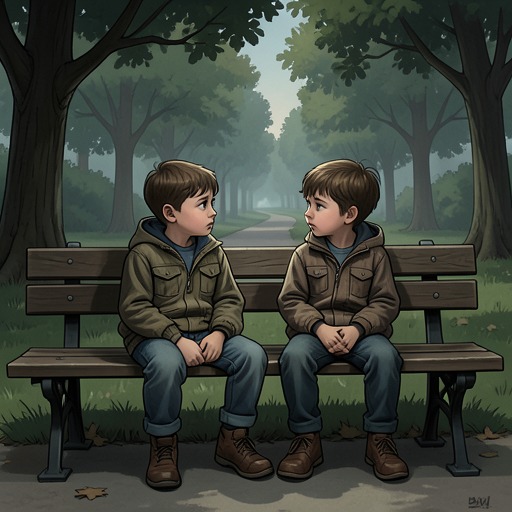
Oskar's knife
Let the Right One InOskar’s knife matters because its role changes in the course of a single visit: carried along as part of Oskar’s plan, held during a game with Eli, and then used in an attempt to make their bond into a pact. It is not simply a tool in this scene. As Oskar brings it from his bag into play and finally into a private ritual, the knife gives physical form to a promise he wants Eli to share. But the scene does not end with that promise completed: Eli does not take the knife, and the evidence leaves their proposed pact open.
Carrying the knife
Oskar packs his workout gear and his knife before going to Eli’s place on Saturday. He expects not to return home before meeting Eli, so the knife travels with him as one of the things he has chosen to bring. The evidence does not say why he packs it at this point. Its importance becomes clearer later, when he draws it from the bag during their play and then handles it while thinking about how to make a pact. The sequence thus links practical possession with a purpose Oskar has not yet explained to Eli.
The knife enters the visit as an object Oskar has on hand, rather than as something Eli supplies or asks for. That distinction matters to the scene’s development: the initiative surrounding it belongs to Oskar. He brings it into the shared space, decides how it will figure in their game, and later makes it the means for proposing a shared act. The object connects a private intention to an interaction between the two children, even though the intention itself remains unspoken until Oskar asks Eli to enter a pact.
From game prop to unused weapon
In the basement corridors, Oskar takes the knife out and declares himself the Knight of Ängby Maybe, casting Eli as a maiden he will rescue from a dragon. The fantasy quickly changes direction: Eli becomes the monster who eats maidens, and Oskar is the one who must fight her. The shift turns the knife into part of an improvised role-playing game, where identities are exchanged rather than fixed. Oskar leaves the knife in its sheath as they run and shout. It is present as a sign of his imagined role, but it is not used against Eli.
Their play is interrupted by the sound of someone opening the basement doors. Oskar and Eli hide together in a food cellar and remain quiet while a man listens outside and then leaves, dismissing the unseen children. Once they are sure he is gone, they crawl out and giggle. The knife has not caused the interruption and does not resolve it; the children manage the moment by hiding. Its place in the scene is therefore deliberately limited: it belongs to their make-believe confrontation, while their response to the real disturbance is to conceal themselves.
This distinction prepares the change in the knife’s function. During the game it signifies an adventure and a role Oskar has announced aloud, yet he keeps it sheathed. Later, alone with Eli on the cellar floor, he looks at it with sustained attention and considers what it might let him do. The object moves from imaginative play toward an actual gesture, and the difference between those uses gives the later scene its weight.
The proposed pact
After Eli says she is tired and continues looking at the ceiling, Oskar studies the knife. He briefly tests its point against his finger, then concludes that this is not the way he wants to proceed. He asks Eli whether she wants to do something and then proposes that they enter into a pact. Eli agrees without first asking what the pact involves. Oskar had imagined explaining his intention if she asked how, but her immediate agreement leaves him to act on the plan he has kept to himself.
Oskar then uses the knife to make a small cut in his palm. He looks at the blood that appears there, and Eli lifts her head. He explains that she need only prick a finger so that they can mix their blood and have their pact. The proposed exchange turns the knife into an instrument for marking mutual commitment: unlike the earlier game, this is not a declared role in an adventure but an invitation to a shared act. Oskar’s use of the object makes visible the difference between wanting a bond and asking Eli to participate in a particular form of it.
Eli does not take the knife when Oskar offers it handle first. He puts it down so that he can catch a drop of blood from his wound and urges her to join him. The available scene does not establish that she accepts, refuses outright, or completes the exchange. The knife’s action in the proposed pact is therefore consequential but incomplete: it enables Oskar to begin his part, while Eli’s response remains unresolved at the point where the evidence ends.
Narrative significance
The knife’s progression is a compact measure of Oskar’s changing purpose. It begins packed among the things he intends to carry, becomes a harmless prop in a game whose roles reverse, and then becomes the focus of a serious proposal. Its material presence allows the scene to move from the playful idea of rescuing or fighting a monster to Oskar’s attempt to make a lasting bond with Eli. The contrast does not make the game a literal rehearsal for the pact; rather, it shows how an object can pass from make-believe into a real interpersonal gesture.
The sequence also keeps intention and outcome distinct. Oskar has a plan, but the evidence reveals it only as he invites Eli to join him; Eli’s yes to the general idea of a pact does not settle what that pact will entail. When Oskar offers the knife, she does not accept it, and the scene stops before the shared act is confirmed. The object thus carries both Oskar’s desire for mutuality and the uncertainty of whether that desire is reciprocated in the specific way he proposes. Its importance lies not in a completed exchange, but in how it makes the question of consent and shared commitment concrete without supplying an answer beyond the moment shown.